How Undersized, Less Athletic Kids Can Finally Hit For Power — Without Sacrificing Contact Quality
Undersized Hitters Adding 30–50 Feet To Their Longball in 8–12 Weeks ... Without Filling Their Head Full Of Mechanical Cues
A movement-first system that fixes the real reason mechanics don't transfer to games.
If you're like most parents of hitters, you've probably already tried a lot of things to help your kid improve.
Private hitting lessons.
Extra cage work.
More reps off the tee.
Maybe even different coaches or different training programs.
And while those things can absolutely help, many families still end up running into the same frustrating problem:
Their hitter understands what they're supposed to do…
…but the swing still keeps falling back into the same patterns.
The same mishits keep showing up.
The same power leaks keep happening.
And the same mechanical flaws keep reappearing — even after they've been pointed out and worked on.
That's not because your hitter isn't trying.
And it's not because coaches don't know what they're talking about.
The real issue is that most hitting instruction focuses on the wrong part of the problem.
And once you understand why that happens, it becomes much easier to understand how hitters can actually make faster, more meaningful improvements.
Why Most Hitting Instruction Fails
Most hitting instruction focuses on mechanics and cues.
You've probably heard them before:
"Keep your elbow up."
"Stay back."
"Don't pull off the ball."
"Keep your hands inside the ball."
"Stay through the zone."
Coaches mean well when they say these things, but the problem is that telling a hitter what to do rarely teaches them how to actually do it.
Because hitting is not just a mechanical skill.
It's a motor learning skill.
When a hitter steps into the box, the swing happens in less than half a second.
That's far too fast for the brain to consciously think through mechanical instructions.
So when a hitter is trying to process cues while reacting to a pitch, the brain defaults to the movement patterns it already trusts the most.
That's why so many hitters experience the same frustrating cycle:
They understand what the coach is saying.
They might even be able to demonstrate the movement correctly in slow motion.
But as soon as the game speeds up…
…the swing falls right back into the old habits.
Not because the hitter is stubborn.
Not because they aren't trying.
But because the movement patterns underneath the swing haven't actually changed.
Real improvement happens when training focuses on teaching the body new movement patterns, not just explaining mechanics.
That's why our system uses constraint-based training instead of relying on verbal cues.
Rather than telling hitters what their swing should look like, we design drills and training environments that force the body to discover the correct movement on its own.
When you combine that approach with fixing the motor control issues underneath the swing, hitters can learn new mechanics faster, more naturally, and with much better retention in games.
And that's exactly what the 5 Layers of Hitting Development system is designed to do.
The 5 Layers Of Hitter Development
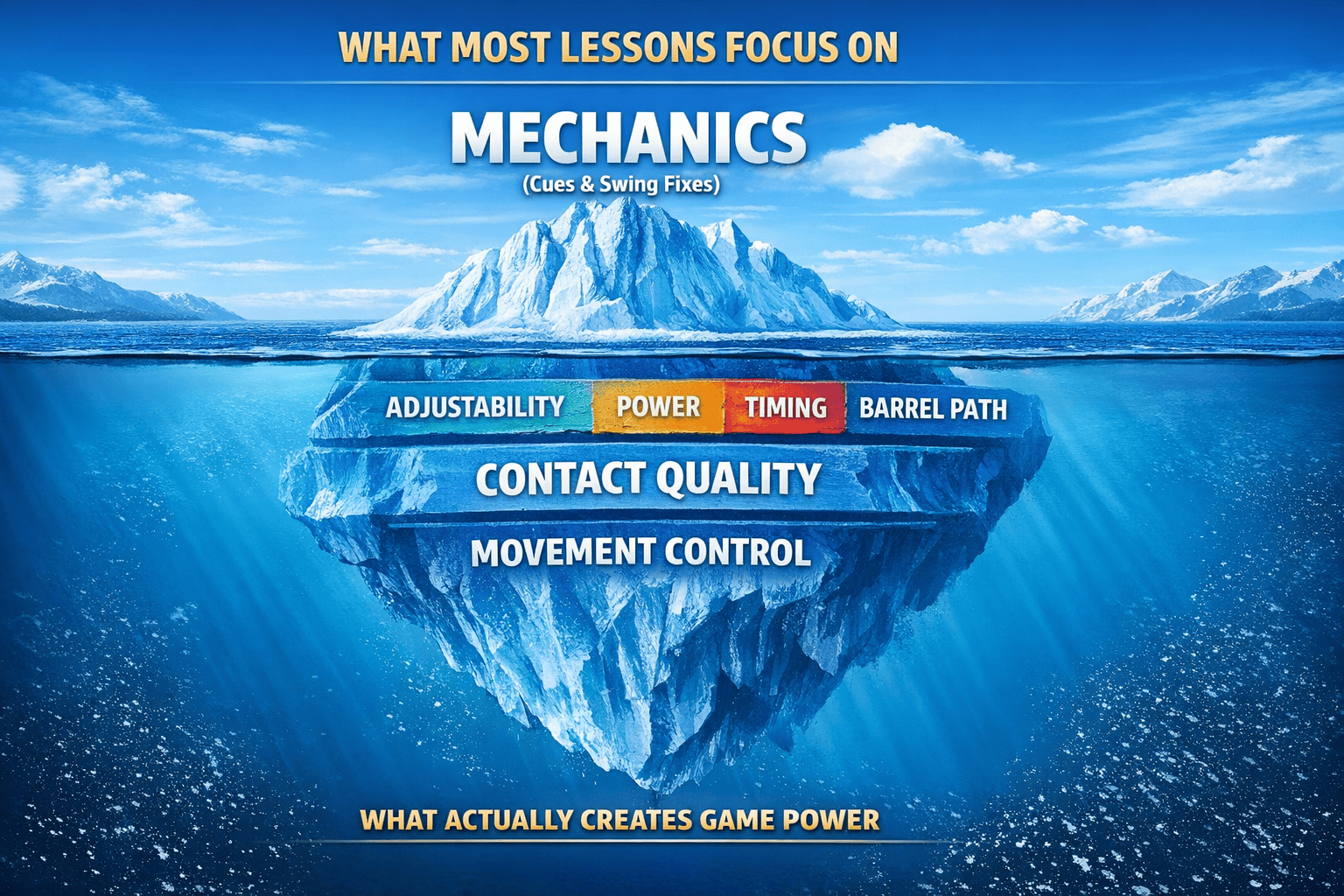
Most hitting instruction only focuses on mechanics.
But mechanics are only one layer.
Real development requires addressing all five.
Correcting Mishits
We analyze how hitters miss the ball to identify where power is leaking out.
On-Plane Training
Constraint drills that teach the barrel to stay through the zone longer.
Timing
Training hitters to sync their body to pitch tempo.
Power Development
Little-bopper mechanics don't create power. We train rotational force through hip-shoulder separation.
Adjustability
The ability to use different swing patterns for different pitch types and locations.
Most coaches jump straight to layers 3–5 because that's what shows up in the swing.
But those layers can't function if the movement underneath them is broken.
That's why our system starts at the foundation — movement. Fix the movement, and the mechanics above it start correcting themselves.
The Missing Piece: Motor Control
Have you ever noticed that your hitter can do a drill correctly in practice… but then the same issue shows up in the game?
That's because drills alone don't change how the body moves under pressure.
Motor control is the brain's ability to coordinate muscles in the right sequence, at the right speed, with the right force.
If a hitter has a motor control limitation — like poor hip-shoulder separation or limited rotational mobility — then no amount of mechanical instruction will fix the swing.
That's why every athlete in our system starts with a movement screen — so we can identify the specific motor control gaps that are limiting their swing.
Once we know what the body can't do yet, we build a training plan that teaches the body first — then layers in the hitting mechanics.
How The System Works
Step 1 — Assessment
We start by analyzing your hitter's swing footage and running a movement screen.
This tells us exactly where their swing is breaking down — and more importantly, why.
We identify the specific motor control limitations that are causing the mechanical issues you're seeing.
Step 2 — Custom Training Plan
Based on the assessment, we build a personalized training plan that targets your hitter's specific gaps.
This isn't a one-size-fits-all program.
Every plan is built around what your hitter's body needs to learn — using constraint-based drills that teach the movement without relying on verbal cues.
Step 3 — Train on Your Schedule
Your hitter performs these exercises and drills during their normal training sessions.
No extra lessons to schedule.
Just structured work built into what they're already doing.
Step 4 — Feedback + Refinement
When they complete their workouts, you record short clips and send them in.
We review everything and send back detailed feedback videos explaining:
- what's improving
- what to focus on next
- what to adjust
Step 5 — Build the Full System
We repeat this process week by week, layering in new pieces as your hitter improves.
This creates a complete, structured training system — not random drills.
This process combines:
- Expert swing analysis
- Constraint-based drill design
- And ongoing specific feedback
Most athletes start seeing improvement quickly because we're not taking things away — we're building on what they already do well.
If This Approach Makes Sense For Your Hitter, There Are Two Ways We Can Help
Some families prefer to go through the training system on their own using our structured online courses.
Others want the added benefit of personalized feedback, where we analyze their hitter's footage and help guide their training.
So we offer two different ways to work with us, depending on how much guidance you'd like along the way.
Choose the option that fits your hitter best below.
Option 1:
Power Pillars: Guided Plan
(Billed 1 Time)
Best if you want my personal help for one week to make sure you get off to a strong start — then you implement the rest yourself.
You get:
You follow the plan. I make sure it's installed correctly.
Start the 9-Week SystemOption 2:
Power Pillars: Coaching Track
(Billed 3 MO/Payments of $299)
Or prepay $750 and save $150
Best if you want my personal help every week — with ongoing adjustments and feedback the entire program.
Everything in Option 1 PLUS:
*This is perfect if you don't trust yourself to diagnose your hitter alone — or if you want the fastest path to clarity.
Apply for Weekly CoachingReal Results From Real Hitters
"This isn't theory — it's the exact system I used with Mason, who went from struggling to make contact to hitting 100mph exit velos and home runs at Perfect Game Nationals… and it's the same process my own undersized kids used to start hitting bombs and competing with the biggest players on the field."
Frequently Asked Questions
Q: What equipment do we need?
A: A bat, tee, net, and a bat sensor (Blast or DK).
Q: How much time does this take?
A: 20–30 minutes, 3–4 days per week.
Q: Can this be done in-season?
A: Yes. The system adapts to game schedules.
Q: Will this conflict with our hitting coach?
A: No. We fill the movement and power gaps most coaches don't address.
Q: When will we see results?
A: Most hitters add 5–7 mph of bat speed within 6–12 weeks when they follow the system.
Two Reasons Not to Wait
I only take 5 new athletes per week for training
After that, new signups roll to the next available week.
Development windows don't wait.
If your hitter is between 7–9 or 13–16, every month lost matters.
About the Creator
Hi, my name is Chet Womach, and in case we haven't met before, you should know that I am compelled by a vision to help use the game of Baseball & Softball to help kids realize that they're stronger than they know. So they grow up realizing that they aren't born victims of their circumstances.
I personally don't know if I could give my kids a greater gift than to have them first experience what it's like to face kids bigger and stronger than they are and struggle... then after working harder and SMARTER at developing over time... coming back and beating those same bigger, stronger, faster competitors a few months later.
The more times we can help our kids face challenges and then be their guide on how to help them overcome them, I believe the more confident they'll be at facing other situations in their life, wherever their life takes them.
It is my hope that I can help your athlete come to this same realization, too. :-)